Working with tools
PowerBuilder provides a variety of tools to help you with
your development work. There
are several ways to open tools:
- Click a button
in the PowerBar for the tool you want - Select the tool from the Tools menu
- Open the New dialog box and select the tool you
want on the Tool tab page
Table 1-5 lists the tools available in the PowerBar.
Some of these tools are also listed on the Tools menu.
| Tool | What you use the tool for |
|---|---|
| To-Do List | Keep track of development tasks you need to do for the current target and create links to get you quickly to the place where you need to complete the tasks. For information, see “Using the To-Do List”. |
| Browser | View information about system objects and objects in your PowerScript target, such as properties, events, functions, and global variables, and copy, export, or print the information. For information, see “Browsing the class hierarchy”. |
| Library painter | Manage libraries, create a new library, build dynamic libraries, and use source control. |
| Database profiles | Define and use named sets of parameters to connect to a particular database. For information, see Connecting to Your Database. |
| EAServer profiles | Define and use named sets of parameters to connect to a particular EAServer host. For information, see Connecting to Your Database. |
| Database painter | For information, see Chapter 15, “Managing the Database.” |
| File Editor | Edit text files such as source, resource, and initialization files. For information, see “Using the file editor”. |
| Debugger | Set breakpoints and watch expressions, step through your application, examine and change variables during execution, and view the call stack and objects in memory. For information, see Chapter 30, “Debugging and Running Applications .” |
Table 1-6 lists
the tools you can launch from the Tool tab page in the New dialog
box.
| Tool | What you use the tool for |
|---|---|
| Migration Assistant | Scans PowerBuilder libraries and highlights usage of obsolete functions and events. For information, see Migration Assistant online Help. |
| DataWindow Syntax | Report on properties of DataWindow objects and the controls within DataWindow objects. For information, see DataWindow Syntax online Help |
| Profiling Class View, Profiling Routine View, and Profiling Trace View |
Use trace information to create a profile of your application. For information, see Chapter 31, “Tracing and Profiling Applications .” |
| PFC Extender | Automatically create and populate an intermediate extension level of libraries (for example, to contain all of your site’s corporate-level extensions to PFC) between two existing levels (such as the PFC ancestor level and the PFC extension level). For information, see PFC Extender online Help and the PowerBuilder Foundation Class Library User’s Guide . |
| Web DataWindow JavaScript Generator | Generate a JavaScript file that contains DataWindow methods you want to associate with a specific DataWindow object. |
Using the To-Do List
The To-Do List displays
a list of development tasks you need to do. You can create tasks
for any target in the workspace or for the workspace itself. A drop-down
list at the top of the To-Do List lets you choose which tasks to display.
To open the To-Do List, click the To-Do List button in the PowerBar or
select Tools>To-Do List from the menu bar.
To-Do List entries
The entries on the
To-Do list are created:
- Automatically by most PowerBuilder wizards
to guide you through the continued development of objects of different
types that you will need to build the application or component specified
by the wizard. - At any time by you when you are working in a painter
and want a link to a task that you want to remember to complete.
Some To-Do List entries created by wizards are hot-linked
to get you quickly to the painter (and the specific object you need)
or to a wizard. You can also create an entry yourself that links
to the PowerBuilder painter where you are working so you can return
to the object or script (event/function and line) you were
working on when you made the entry. When you move the pointer over entries
on the To-Do list, the pointer changes to a hand when it is over
a linked entry.
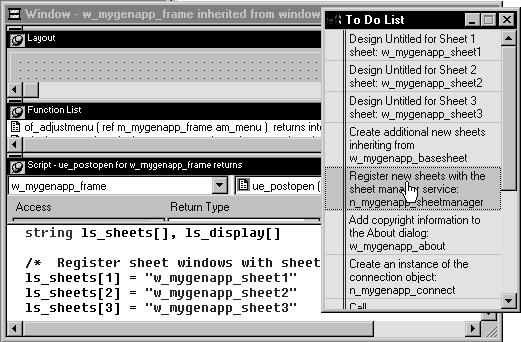
For example, if you
generate an MDI application with the Template Application wizard,
one of the linked entries on the To-Do List reminds you to register
new sheets with the sheet manager service, which is a nonvisual
user object created by the wizard. Double-clicking this
entry automatically opens the Window painter and the Script view
where you register new sheets.
Exporting and importing lists
You can export or import a To-Do List by selecting Export
or Import from the pop-up menu. Doing this is useful if you want
to move from one computer to another or you need to work with To-Do
Lists as part of some other system such as a project management
system.
 Linked entries If you import a list from another workspace or target, or
from a previous version of PowerBuilder, linked entries will display
in the list but the links will not be active.
Working with entries on the To-Do List
Table 1-7 tells you how to work with entries
on the To-Do List.
| To do this | Do this |
|---|---|
| See linked entries | Move the pointer over the entries. A hand displays when the entry you are over is linked. |
| Use a linked entry to get to a painter or wizard |
Double-click the linked entry or select it and then select Go To Link from the pop-up menu. |
| Add an entry with no link | Select Add from the pop-up menu. |
| Add a linked entry to a painter that edits objects |
With the painter open, select Add Linked from the pop-up menu. |
| Add an entry for a specific target | If the To-Do List is open, select the target from the drop-down list at the top of the To-Do List and add the entry. If the To-Do List is closed, select a target in the System |
| Add an entry for the workspace | Select Current Workspace from the drop-down list at the top of the To-Do List and add the entry. |
| Change the list that displays | Select a specific target or Current Workspace from the drop-down list at the top of the To-Do List. To display tasks for all targets and the workspace, select All Items. |
| Change an entry’s position on the list |
Drag the entry to the position you want. |
| Edit or delete an entry | Select Edit or Delete from the pop-up menu. |
| Delete checked entries or all entries | Select Delete Checked or Delete All from the pop-up menu. |
| Check or uncheck an entry | Click in the margin to the left of the entry or select an entry and then select Check/Uncheck from the pop-up menu. |
| Export a To-Do List | Select Export from the pop-up menu, name the To-Do List text file, and click Save. |
| Import a To-Do List | Select Import from the pop-up menu, navigate to an exported To-Do List text file, and click Open. |
Using the file editor
One of the tools on the PowerBar and Tools menu is a text
editor that is always available. Using the editor, you can view
and modify text files (such as initialization files and tab-separated
files with data) without leaving PowerBuilder. Among the features the file editor provides
are find and replace, undo, importing and exporting text files,
and dragging and dropping text.
Setting file editing properties
The file editor has font properties and an indentation property
that you can change to make files easier to read. If you do not
change any properties, files have black text on a white background
and a tab stop setting of 3 for indentation. Select Design>Options
from the menu bar to change the tab stop and font settings.
Editor properties apply elsewhere When you set properties for the file editor, the settings
also apply to the Function painter, the Script view, the Source
editor, the Interactive SQL view in the Database painter, and the
Debug window.
Dragging and dropping text
To move text, simply select it, drag it to its new location,
and drop it. To copy text, press the Ctrl key while you drag and
drop the text.