About working with database components
A database is an electronic storage place for data. Databases
are designed to ensure that data is valid and consistent and that
it can be accessed, modified, and shared.
A database management system (DBMS) governs
the activities of a database and enforces rules that ensure data
integrity. A relational
DBMS stores and organizes
data in tables.
How you work with databases in PowerBuilder You can use PowerBuilder to work with the following database
components:
- Tables and columns
- Keys
- Indexes
- Database views
- Extended attributes
- Additional database components
Tables and columns
A database usually has many tables, each of which contains
rows and columns of data. Each row in a table has the same columns,
but a column’s value for a particular row could be empty
or NULL if the column’s definition allows it.
Tables often have relationships with other tables. For example,
in the EAS Demo DB that is included with PowerBuilder, the Department
table has a Dept_id column, and the Employee table also
has a Dept_id column that identifies the department in
which the employee works. When you work with the Department table
and the Employee table, the relationship between them is specified
by a join of the two tables.
Keys
Relational databases use keys to ensure database integrity.
Primary keys A primary key is a column or set of
columns that uniquely identifies each row in a table. For example,
two employees may have the same first and last names, but they have
unique ID numbers. The Emp_id column in the Employee table
is the primary key column.
Foreign keys A foreign key is a column or set of
columns that contains primary key values from another table. For
example, the Dept_id column is the primary key column in
the Department table and a foreign key in the Employee table.
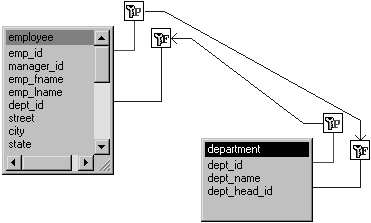
Key icons In PowerBuilder, columns defined as keys are displayed with key icons that
include a P for primary or F for foreign. PowerBuilder automatically joins
tables that have a primary/foreign key relationship, with
the join on the key columns:
For more information, see “Working with keys”.
Indexes
An index is a column or set of columns
you identify to improve database performance when searching for
data specified by the index. You index a column that contains information
you will need frequently. Primary and foreign keys are special examples
of indexes.
You specify a column or set of columns with unique values
as a unique index, represented by an icon
with a single key.
You specify a column or set of columns that has values that
are not unique as a duplicate index, represented
by an icon with two keys.
For more information, see “Working with indexes”.
Database views
If you often select data from the same tables and columns,
you can create a database view of the tables.
You give the database view a name, and each time you refer to it
the associated SELECT command executes to find the data.
Database views are listed in the Objects view of the Database
painter and can be displayed in the Object Layout view, but a database
view does not physically exist in the database in the same way that
a table does. Only its definition is stored in the database, and
the view is re-created whenever the definition is used.
Database administrators often create database views for security
purposes. For example, a database view of an Employee table that
is available to users who are not in Human Resources might show
all columns except Salary.
For more information, see “Working with database views “.
Extended attributes
Extended attributes enable you to store
information about a table’s columns in special system tables.
Unlike tables, keys, indexes, and database views (which are DBMS-specific)
extended attributes are PowerBuilder-specific. The most powerful extended
attributes determine the edit style, display format, and validation
rules for the column.
For more information about extended attributes,
see “Specifying column extended
attributes”.
For more information about the extended attribute system tables,
see Appendix A, “The Extended
Attribute System Tables”.
Additional database components
Depending on the database to which you are connected and on
your user privileges, you may be able to view or work with a variety
of additional database components through PowerBuilder. These components
may include:
- Driver information
- Groups
- Metadata types
- Procedures and functions
- Users
- Logins
For example, driver information is relevant to ODBC connections.
It lists all the ODBC options associated with the ODBC driver, allowing
you to determine how the ODBC interface will behave for a given
connection. Login information is listed for Adaptive Server Enterprise
(SYC) and Microsoft SQL Server (MSS) database connections. Groups
and users information is listed for several of the databases and
allows you to add new users and groups and maintain passwords for
existing users.