Customizing toolbars
You can customize toolbars with PowerBuilder buttons and with
buttons that invoke other applications, such as a clock or text
processor.
Adding, moving, and deleting buttons
You can add, move, and delete buttons in any toolbar.
 To add a button to a toolbar:
-
Position the pointer on the toolbar and
display the pop-up menu. -
Select Customize.
The Customize dialog box displays. The icons that display
in the selected palette and current toolbar panes depend on the
palette and toolbar you select.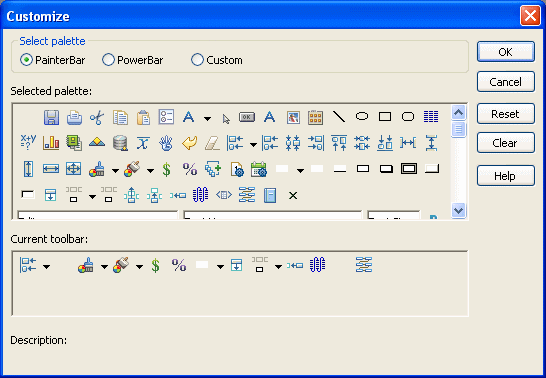
-
Click the palette of buttons you want to use in
the Select Palette group box. -
Choose a button from the Selected Palette box
and drag it to the position you want in the Current Toolbar box.The function of the button you selected displays in the Description
at the bottom of the dialog box. If you choose a button from the
Custom palette, another dialog box displays so you can define the
button.For more information, see “Adding a custom button”.
To move a button on a toolbar:
-
Position the pointer on the toolbar, display
the pop-up menu, and select Customize. -
In the Current toolbar box, select the button
and drag it to its new position.
To delete a button from a toolbar:
-
Position the pointer on the toolbar, display
the pop-up menu, and select Customize. -
In the Current toolbar box, select the button
and drag it outside the Current toolbar box.
Resetting a toolbar
You can restore the original setup of buttons on a toolbar
at any time.
To reset a toolbar:
-
Position the pointer on the toolbar, display
the pop-up menu, and select Customize. -
Click the Reset button, then Yes to confirm, then
OK.
Clearing or deleting a toolbar
Whenever you want, you can remove all buttons from a toolbar.
If you do not add new buttons to the empty toolbar, the toolbar
is deleted. You can delete both built-in toolbars and toolbars you
have created.
 To recreate a toolbar
If you delete one of PowerBuilder’s built-in toolbars,
you can recreate it easily. For example, to recreate the PowerBar,
display the pop-up menu, select New, and then select PowerBar1 in
the New Toolbar dialog box.
For information about creating new toolbars and about the
meaning of PowerBar1, see “Creating new toolbars”.
To clear or delete a toolbar:
-
Position the pointer on the toolbar, display
the pop-up menu, and select Customize. -
Click the Clear button, then Yes to confirm.
The Current toolbar box in the Customize dialog box is emptied.
-
If you want to add new buttons, select them.
-
Click OK to save the toolbar if you added new
buttons, or delete the toolbar if you did not.
Adding a custom button
You can add a custom button to a toolbar. A custom button
can:
-
Invoke a PowerBuilder
menu item -
Run an executable (application) outside PowerBuilder
-
Run a query or preview a DataWindow object
-
Place a user object in a window or in a custom user
object -
Assign a display format or create a computed field
in a DataWindow object
To add a custom button:
-
Position the pointer on the toolbar, display
the pop-up menu, and select Customize. -
Select Custom in the Select Palette group box.
The custom buttons display in the Selected Palette box.
-
Select a custom button and drag it to where you
want it in the Current Toolbar box.The Toolbar Item Command dialog box displays. Different buttons
display in the dialog box depending on which toolbar you are customizing: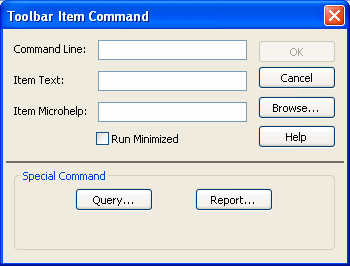
-
Fill in the Command Line box using Table 2-2.
-
In the Item Text box, specify the text associated
with the button in two parts separated by a comma: the text that
displays on the button and text for the button’s PowerTip:1<span>ButtonText, PowerTip</span>For example:
1Save, Save FileIf you specify only one piece of text, it is used for both
the button text and the PowerTip. -
In the Item MicroHelp box, specify the text to
appear as MicroHelp when the pointer is on the button.
|
Button action |
Toolbar Item Command dialog |
||||||
|---|---|---|---|---|---|---|---|
|
Invoke a PowerBuilder menu item |
Type @MenuBarItem.MenuItem in
If a menu label contains a dot (“.”), you
You can also use a number to refer to a menu item. The first
|
||||||
|
Run an executable file outside PowerBuilder |
Type the name of the executable file To search for the file name, click the Browse button. |
||||||
|
Run a query |
Click the Query button and select the |
||||||
|
Preview a DataWindow object |
Click the Report button and select a |
||||||
|
Select a user object for placement in |
(Window and User Object painters only) |
||||||
|
Assign a display format to a column in |
(DataWindow painter only) Click the Format For more about specifying display formats, see Chapter 22, “Displaying and Validating |
||||||
|
Create a computed field in a DataWindow object |
(DataWindow painter only) Click the Function |