Using stored procedures to update the database
Updates to the database can be performed using stored procedures.
Why use stored procedures?
The DataWindow control submits updates to the database by
dynamically generating INSERT, DELETE, and UPDATE SQL statements
after determining the status of each row in the DataWindow object.
You can also define procedural SQL statements in a stored procedure
for use by all applications accessing a database. Using stored procedures
to perform database updates allows you to enhance database security,
integrity, and performance. Since stored procedures provide for
conditional execution, you can also use them to enforce additional
business rules.
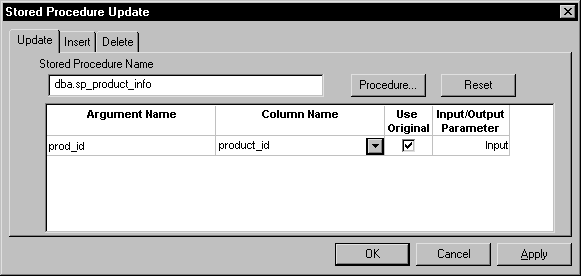
Updating using stored procedures
 To use stored procedures to update the database
-
In the DataWindow painter, select Rows>Stored
Procedure Update to display the Stored Procedure Update dialog box. -
Select the tab for the SQL update method (Delete,
Insert, or Update) with which you want to associate a stored procedure. -
Select the stored procedure you want to be executed
when the SQL update method is generated. Specifying stored procedures The Stored Procedure Update dialog box only allows you to
associate an existing stored procedure with your DataWindow object.
The stored procedure must have been previously defined in the database. -
The parameters used in the stored procedure are
displayed in the Argument Name list in the order they are defined
in the procedure.Column Name lists the columns used in your DataWindow object.
You must associate a column in the DataWindow object with a procedure parameter. Matching a column to a procedure parameter You must be careful to correctly match a column in the DataWindow object
to a procedure parameter, since PowerBuilder is only able to verify that
data types match. -
If the parameter is to receive a column value,
you must also indicate whether the parameter will receive the updated
column value entered via the DataWindow object or retain the original
column value from the database. Typically, you would select Use
Original when the parameter is used in a WHERE clause in an UPDATE
or DELETE SQL statement. If you don’t select Use Original,
the parameter will use the new value entered for that column. Typically,
you would use the new value when the parameter is used in an INSERT
or UPDATE SQL statement.If a stored procedure uses parameters that are not matched
to column names, you may substitute the value from a DataWindow
object computed field or expression.
What happens when the stored procedure is executed
The stored procedure you associate with a SQL update method
in the Stored Procedure Update dialog box is executed when the DataWindow
control calls the Update function. The DataWindow control examines
the table in the Datawindow object, determines the appropriate SQL
statement for each row, and submits the appropriate stored procedure
(as defined in the Stored Procedure Update dialog box) with the
appropriate column values substituted for the procedure arguments.
If a stored procedure for a particular SQL update method is
not defined, the DataWindow control submits the appropriate SQL
syntax in the same manner it always has.
Return values from procedures can not be handled by the DataWindow
control. The Update function will return 1 if it succeeds and -1
if an error occurs. Additional information is returned to SQLCA.
Using Describe and Modify
You can use the DataWindow Describe and Modify functions to
access DataWindow property values including the stored procedures
associated with a DataWindow object.
For information, see the DataWindow object property Table.property
in the DataWindow Reference
.
Restrictions on the use of Modify Since a database driver can only report stored procedure names
and parameter names and position, it cannot verify that changes
made to stored procedures are valid. Consequently, if you use Modify to
change a stored procedure, be careful that you do not inadvertently
introduce changes into your database.
In addition, using Modify to enable a DataWindow object to
use stored procedures to update the database when it is not already
using stored procedures requires that the type qualifier be specified
first. Calling the type qualifier ensures that internal structures
are built before subsequent calls to Modify. If a new method or
method arguments are specified without a preceding definition of
type, the Modify will fail.