The inheritance hierarchy
When you build an object that inherits from another object,
you are creating a hierarchy (or tree structure) of ancestor objects
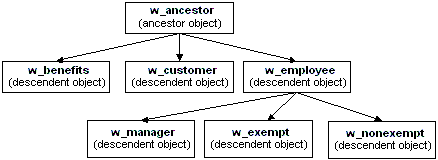
and descendent objects. Chapter 11, “Working with Windows,” uses the example of creating two windows, w_customer and w_employee,
that inherit their properties from a common ancestor, w_ancestor.
In this example, w_employee and w_customer are
the descendants.
The object at the top of the hierarchy is a base class object,
and the other objects are descendants of this object. Each descendant
inherits information from its ancestor. The base class object typically
performs generalized processing, and each descendant modifies the
inherited processing as needed.
Multiple descendants
An object can have an unlimited number of descendants, and
each descendant can also be an ancestor. For example, if you build
three windows that are direct descendants of the w_ancestor window
and three windows that are direct descendants of the w_employee window,
the hierarchy looks like this: