Rotating controls in a DataWindow object
Controls that display text such as text controls and computed
fields can be rotated from the original baseline of the text. The
Escapement property on the Font property page for the control lets you
specify the amount of rotation, also known as escapement.
Several other properties of a rotated control affect its final
placement when the DataWindow object runs. The location of the control
in Design view, the amount of rotation specified for it, and the
location of the text within the control (for example, centered text as
opposed to left-aligned text) all contribute to what you see in the
DataWindow object Preview view.
The following procedure includes design practices that help ensure
that you get the final results you want. As you become more experienced,
you can drop or alter some of the steps. The procedure recommends making
the control movable in the Preview view, which is often helpful.
To rotate a control in a DataWindow object:
-
Select the control in the Design view.
-
Make it movable (Position property page>Moveable check
box). -
In Design view, enlarge the area in which the control is
placed.For example, in a grid DataWindow object, make the band deeper
and move the control down into the center of the band. -
Display the Modify expression dialog box for the Escapement
property. (Click the button next to the Escapement property on the
Font property page.) -
Specify the amount of rotation you want as an integer in
tenths of a degree. (For example, 450 means 45 degrees of rotation;
0 means horizontal or no rotation.)The origin of rotation is the center of the top border of the
box containing the text. It is often helpful to use left-aligned
text (General property page>Alignment>Left) because it makes
it easier to position the control correctly. This example shows
left-aligned text within two controls, a text control and a computed
field.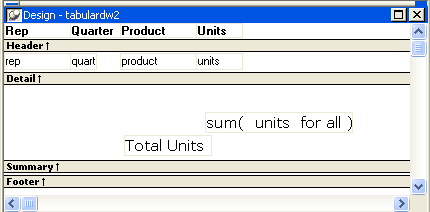
If the box that contains the text overlaps the border of the
page or the border of a label in a DataWindow object with the Label
presentation style, the origin of rotation is the center of the
portion of the top border that is within the page or label, and the
portion that is outside the page or label is cut off. This can cause
the text in the box to run to a second line when it is rotated. If
you want the text to display close to the border, you can add one or
more line breaks (“~r~n”) before the text and adjust the size of the
box.To display the current rotation in Preview, close the Preview
view and reopen it (View>Preview on the menu bar).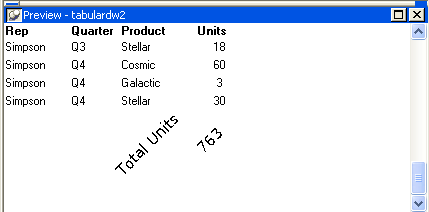
-
Drag and drop the control in the Design view until it is where
you want it. -
In the Design view, select the control that is being rotated
and deselect the Moveable check box.
If you are using a conditional expression for rotation
If you are specifying different rotations depending on
particular conditions, you might need to add conditions to the x and y
properties for the control to move the control conditionally to match
the various amounts of rotation. An alternative to moving the control
around is to have multiple controls positioned exactly as you want
them, taking into account the different amounts of rotation. Then you
can add a condition to the visible property of each control to ensure
that the correctly rotated control shows.