PowerBuilder
techniques
PowerBuilder provides full support for inheritance, encapsulation,
and polymorphism in both visual and nonvisual objects.
Creating reusable objects
In most cases, the person developing reusable objects is not the
same person using the objects in applications. This discussion describes
defining and creating reusable objects. It does not address
usage.
Implementing inheritance
PowerBuilder makes it easy to create descendant objects. You
implement inheritance in PowerBuilder by using a painter to inherit from a
specified ancestor object.
For examples of inheritance in visual objects, see the
w_employee window and u_employee_object in the Code Examples sample
application.
Example of ancestor service object
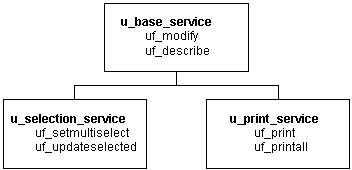
One example of using inheritance in custom class user objects is
creating an ancestor service object that performs basic services and
several descendant service objects. These descendant objects perform
specialized services, as well as having access to the ancestor’s
services:
Figure: Ancestor service object
Example of virtual function in ancestor
object
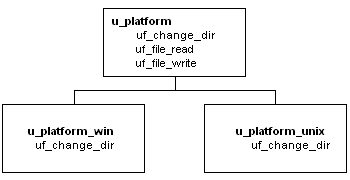
Another example of using inheritance in custom class user objects is
creating an ancestor object containing functions for all platforms and
then creating descendant objects that perform platform-specific functions.
In this case, the ancestor object contains a virtual function
(uf_change_dir in this example) so that developers can create descendant
objects using the ancestor’s datatype.
Figure: Virtual function in ancestor object
For more on virtual functions, see Other techniques.
Implementing encapsulation
Encapsulation allows you to insulate your object’s data, restricting
access by declaring instance variables as private or protected. You then
write object functions to provide selective access to the instance
variables.
One approach
One approach to encapsulating processing and data is as
follows:
-
Define instance variables as public, private, or protected,
depending on the desired degree of outside access. To ensure complete
encapsulation, define instance variables as either private or
protected. -
Define object functions to perform processing and provide access
to the object’s data.To do this
Provide this function
Example
Perform processing
uf_do_operation
uf_do_retrieve (which retrieves rows from the
database)Modify instance variables
uf_set_variablename
uf_set_style (which modifies the is_style string
variable)Read instance variables
uf_get_variablename
uf_get_style (which returns the is_style string
variable)(Optional) Read boolean instance
variablesuf_is_variablename
uf_is_protected (which returns the ib_protected
boolean variable)
Another approach
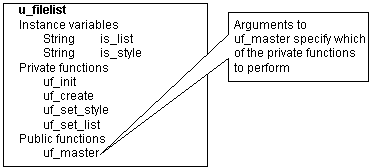
Another approach to encapsulating processing and data is to provide
a single entry point, in which the developer specifies the action to be
performed:
-
Define instance variables as private or protected, depending on
the desired degree of outside access -
Define private or protected object functions to perform
processing -
Define a single public function whose arguments indicate the
type of processing to performFigure: Defining a public function for encapsulation
For an example, see the uo_sales_order user object in the Code
Examples sample application.
Implementing polymorphism
Polymorphism refers to a programming language’s ability to process
objects differently depending on their datatype or class. Polymorphism
means that functions with the same name behave differently depending on
the referenced object. Although there is some discussion over an exact
definition for polymorphism, many people find it helpful to think of it as
follows:
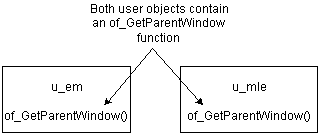
Operational polymorphism
Separate, unrelated objects define functions with the same name.
Each function performs the appropriate processing for its object
type:
Figure: Operational polymorphism
For an example, see the u_external_functions user object and its
descendants in the Code Examples sample application.
Inclusional polymorphism
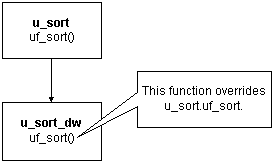
Various objects in an inheritance chain define functions with the
same name.
With inclusional polymorphism PowerBuilder determines which version
of a function to execute, based on where the current object fits in the
inheritance hierarchy. When the object is a descendant, PowerBuilder
executes the descendant version of the function, overriding the ancestor
version:
Figure: Inclusional polymorphism
For an example, see the u_employee_object user object in the Code
Examples sample application.