Integrating with EAServer
EAServer is a middle-tier,
component transaction server that hosts executable business objects
called components. You can access components on Enterprise Application Server from
your Web applications.
EAServer can host various types of components including
PowerBuilder objects and Java classes or beans. Although these components
have different origins, they have several things in common. These
components:
- Encapsulate business logic that
one or more applications need to execute - Shift processing to the middle-tier EAServer server,
enabling application clients to remain thin - Are stored in packages and contain methods that
clients can call to perform specific operations
Developers typically create components using tools such as PowerJ or PowerBuilder.
These tools enable developers to build classes or objects and deploy
them directly to EAServer as components. For more information
about EAServer, see the Jaguar CTS Programmer’s
Guide
.
Access to components
You can take advantage of the Web Target user interface to
access EAServer components by using:
- 4GL Web pages to help you create server scripts that access Enterprise Application Server components.
- Web DataWindow DTCs to let you access Web DataWindow server components available
on EAServer. The Web DataWindow retrieves, processes, and displays
data on a page while EAServer manages the database connection.
4GL Web pages
4GL Web pages give you quick access to EAServer components
by:
- Letting you bind page controls to EAServer component
properties - Giving your scripts access to EAServer components
as represented by variables - Providing drag-and-drop programming access to methods
of Enterprise Application Server components
For more information about 4GL Web pages see Chapter 8, “Developing 4GL Web Pages”.
Web DataWindow DTC
The Web DataWindow DTC provides a design-time interface that
lets you select the DataWindow objects to include on a Web page.
It also permits you to override certain settings of the DataWindow
object before the Web DataWindow displays in the client browser.
4GL Web pages also provide enhancements for Web DataWindow
objects available through EAServer. A server representation of
a Web DataWindow object (the PSWebDataWindowClass object) allows
you to write server-side scripts for DataWindow events and methods.
For more information about the Web DataWindow DTC, see Chapter 9, “About the Web DataWindow Design-Time
Control”.
Accessing components
Before
a page can access an EAServer component, you must set up a connection
to EAServer from your Web target. With a connection to the server established,
you can:
- View a list of accessible servers
from the Components tab page of the System Tree - Display the packages, components, and methods installed
on EAServer - Get information about a component or method
You can drag and drop a component from the System Tree to
a Web page that is open in Page view of the HTML editor. This opens
the Page Properties dialog box to the EAServer page, and adds the
component to the list of components available to the Web page.
Before you view information about or include an EAServer component
on your Web page, you must make sure a profile exists for the server
containing a component you want to use. Also, you must make sure
the Enterprise Application Server has an IIOP listener configured before you set up
a connection for your Web target. A connection from a Web target
to Enterprise Application Server uses the Internet Inter-ORB Protocol (IIOP).
 To define an Enterprise Application Server connection profile:
-
Select Tools>EAServer Profile
from the PowerBuilder menu.or
Right-click anywhere in the Components tab page of the
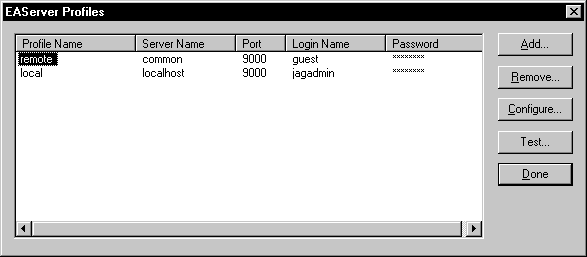
System Tree and select EAServer Servers from the popup menu.The EAServer Server Profiles dialog box displays.
-
Edit the list of EAServer profiles.
You can add, modify (configure), or remove Enterprise Application Server connections
as needed. You can also select a connection and test it. (Make sure
the server is running before you test the connection.) -
Click Done to save your changes.
An item representing the server appears under the EAServer
Servers node on the Components tab page of the System Tree.
Viewing components
After you establish a connection to an Enterprise Application Server for your
Web target, you can see the components and the methods for those
components installed on the server.
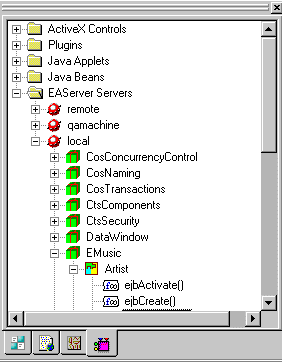
You can also view
the list of server components from the Page Properties dialog box
for 4GL Web pages. When you add a Web DataWindow DTC to a page,
you can select a DataWindow component from the Web DataWindow DTC
Properties dialog box–the DataWindow HTMLGenerator80 component is
selected and enabled by default.
Getting information about components and methods
After you define a connection, you can get information about
components and component methods from the System Tree.
To get information about EAServer components
and methods:
-
From the Components tab of the System Tree,
expand the Enterprise Application Server Servers branch. -
Expand the appropriate server and package to find
the component you want information about.
or
Expand
the appropriate server, package, and component to find the method
you want information about. -
Right-click that component or method and select
Properties from the popup menu.The properties dialog box for the selected component or method
displays: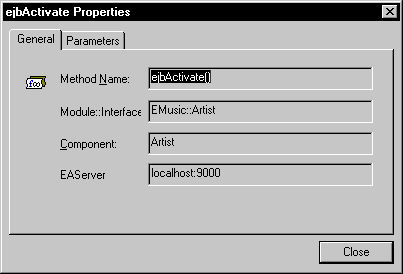
Method properties have a Parameters tab to display the parameters
of the component method. -
(Optional) Click the Parameter tab to see information
about the parameters the method uses.