Building two windows with similar definitions
Assume your application needs two windows with similar definitions.
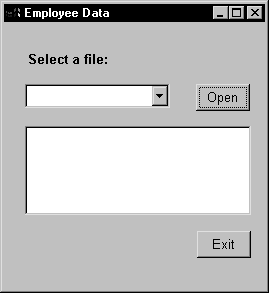
One window, w_employee, needs:
-
A title (Employee
Data) -
Text that says
Select a file: -
A drop-down list with a list of available employee
files -
An Open button with a script that opens the selected
file in a multiline edit box -
An Exit button with a script that asks the user
to confirm closing the window and then closes the window
The window looks like this:
The only differences in the second window, w_customer,
are that the title is Customer Data, the drop–down list
displays customer files instead of employee files, and there is
a Delete button so the user can delete files.
Your choices
To build these windows, you have three choices:
-
Build two new windows from
scratch as described in “Building a new window” -
Build one window from scratch and then modify it
and save it under another name -
Use inheritance to build two windows that inherit
a definition from an ancestor window
Using inheritance
To build the two windows using inheritance, follow these steps:
-
Create an ancestor window, w_ancestor,
that contains the text, drop-down list, and the open and exit buttons,
and save and close it.
You cannot inherit a window from an existing window
when the existing window is open, and you cannot open a window when
its ancestor or descendant is open. -
Select File>Inherit, select w_ancestor in
the Inherit From dialog box, and click OK. -
Add the Employee Data title, specify that the DropDownListBox
control displays employee files, and save the window as w_employee. -
Select File>Inherit, select w_ancestor in
the Inherit From dialog box, and click OK. -
Add the Customer Data title, specify that the DropDownListBox
control displays customer files, add the Delete button, and save
the window as w_customer.