About DataWindow data expressions
The Object property of the DataWindow control lets you specify
expressions that refer directly to the data of the DataWindow object
in the control. This direct data manipulation allows you to access
small and large amounts of data in a single statement, without calling
methods.
There are several variations of data expression syntax, divided
into three groups. This section summarizes these syntaxes. The syntaxes
are described in detail later in this chapter.
Data in columns or computed fields when you know
the name
One or all items
(if rownum is absent, include either buffer or datasource)
|
1 |
<span>dwcontrol</span>.Object.<span>columnname</span> {.<span>buffer</span> } {.<span>datasource</span> } { [ <span>rownum </span>] } |
Returns a single value (for a specific row number) or an array
of values (when rownum is omitted) from the
column.
See “Syntax for one or all data
items in a named column”.
Selected items
|
1 |
<span>dwcontrol</span>.Object.<span>columnname</span> {.Primary }{.<span>datasource</span> }.Selected |
Returns an array of values from the column with an array element
for each selected row.
See “Syntax for selected data
in a named column”.
Range of items
|
1 |
<span>dwcontrol</span>.Object.<span>columnname</span> {.<span>buffer</span> } {.<span>datasource</span> } [<span> startrownum</span>, <br> <span>endrownum</span> ] |
Returns an array of values from the column with an array element
for each row in the range.
See “Syntax for a range of data
in a named column”.
Data in numbered columns
Single items
|
1 |
<span>dwcontrol</span>.Object.Data {.<span>buffer</span> } {.<span>datasource</span> } [<span> rownum</span>, <span>colnum</span> ] |
Returns a single item whose datatype is the datatype of the
column.
See “Syntax for a single data
item in a DataWindow”.
Blocks of data
involving a range of rows and columns
|
1 |
<span>dwcontrol</span>.Object.Data {.<span>buffer</span> } {.<span>datasource</span> } [<span> startrownum</span>,<br> <span>startcolnum</span>, <span>endrownum</span>, <span>endcolnum</span> ] |
Returns an array of structures or user objects. The structure
elements match the columns in the range. There is one array element
for each row in the range.
See “Syntax for data in a block
of rows and columns”.
Whole rows
Single row or all rows
|
1 |
<span>dwcontrol</span>.Object.Data {.<span>buffer</span> } {.<span>datasource</span> } { [<span> rownum</span> ] } |
Returns one structure or user object (for a single row) or
an array of them (for all rows). The structure elements match the
columns in the DataWindow object.
See “Syntax for data in a single
row or all rows”.
Selected rows
|
1 |
<span>dwcontrol</span>.Object.Data {.Primary } {.<span>datasource</span> } .Selected |
Returns an array of structures or user objects. The structure
elements match the columns in the DataWindow object. There is one
array element for each selected row.
See “Syntax for all data from
selected rows”.
Summary of syntaxes
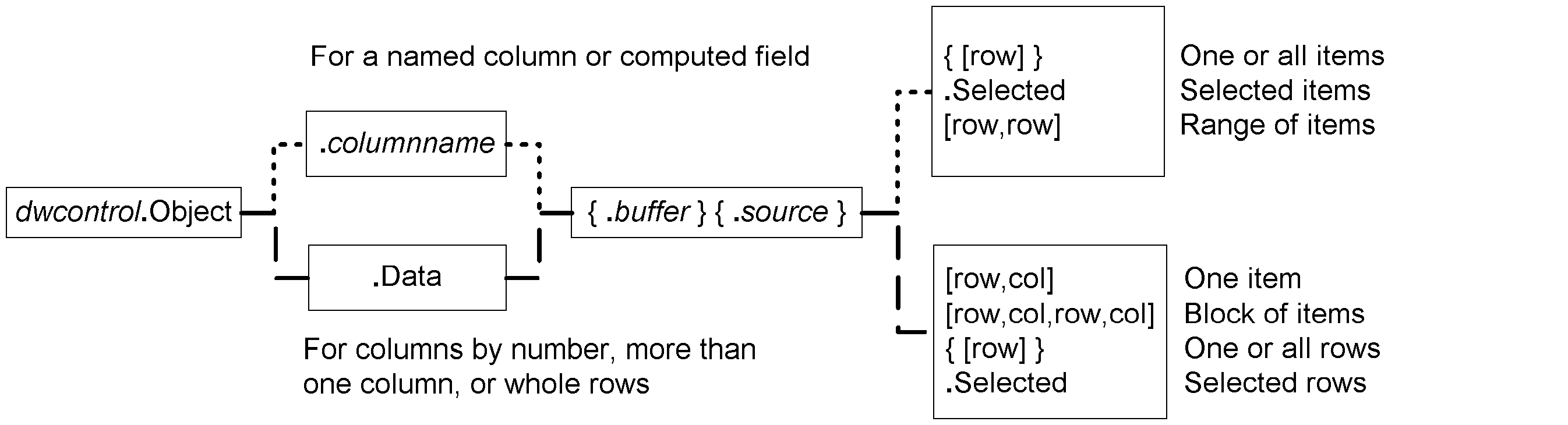
This diagram summarizes the variations in data expression
syntax:
Figure 4-1: Variations in data expression syntax
For information about getting and setting
values of DataWindow object properties using a similar syntax, see Chapter 5, “Accessing DataWindow Object Properties
in Code .”