Creating a new TreeView DataWindow
You use the TreeView wizard and the DataWindow painter to
create a TreeView DataWindow.
TreeView creation process
A TreeView DataWindow has multiple levels, each of which is
a node in the TreeView. You use the TreeView wizard to create a
TreeView DataWindow, but the wizard produces a DataWindow that includes
only the top level of the TreeView.
Creating a complete TreeView DataWindow involves three steps:
- Using the TreeView DataWindow wizard
to create the top level (level 1) of the TreeView DataWindow. - Using the DataWindow painter to add additional levels to
the TreeView DataWindow. - Setting TreeView DataWindow properties to customize
the TreeView style.
For information about adding and deleting TreeView levels,
see “Adding and deleting TreeView
levels”. For information about
setting properties in the DataWindow painter, see “Setting properties for the
TreeView DataWindow”.
You can use TreeView DataWindow methods to expand and collapse
TreeView nodes, and you can write code for TreeView DataWindow events
that are fired when a node is expanded or collapsed. For detailed
information about using TreeView DataWindow properties, methods,
and events, see the DataWindow Reference
or
the online Help.
Creating a TreeView DataWindow
 To create a TreeView DataWindow:
-
Select File>New from the menu
bar and select the DataWindow tab. -
If there is more than one target in the workspace,
select the target where you want to create the DataWindow from the
drop-down list at the bottom of the dialog box. -
Choose the TreeView presentation style for the DataWindow and
click OK.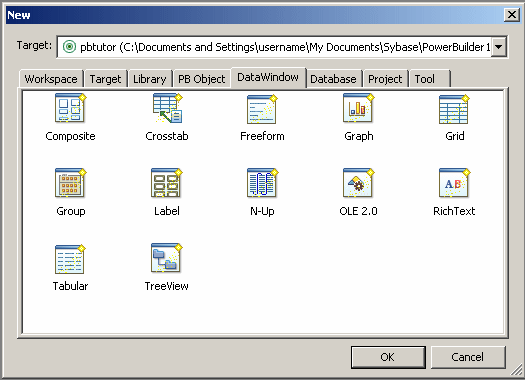
-
Select the data source you want to use.
You are prompted to specify the data.
-
Define the tables and columns you want to use.
You are prompted to specify the TreeView grouping columns.
 Multiple columns and multiple TreeView levels You can specify more than one column, but all columns apply
to TreeView level one. At this point, you can define only one TreeView
level. You define additional levels later.In the following example, TreeView grouping will be by department,
as specified by the dept_id column: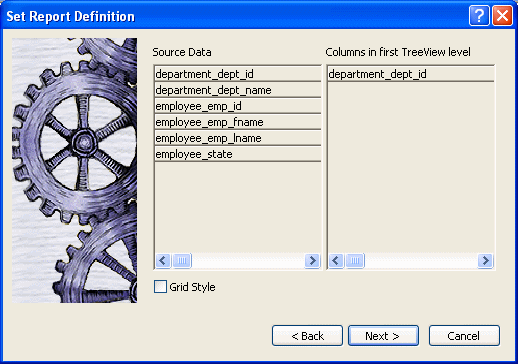
If you want to use an expression, you can define it when you
have completed the wizard. See “Using an expression for
a column name”.The sample DataWindow shown in “Example” uses the department and employee
tables in the EAS Demo DB database. -
Specify the column or columns that will be at
the top level (level 1) of the TreeView DataWindow.The sample DataWindow uses the department name as the top
level. If you want to display both the department ID and department
name, you specify that both columns are at the top level. -
If you want the TreeView DataWindow to display
grid lines, select the Grid Style check box.When you select the Grid Style check box, the TreeView DataWindow displays
grid lines for rows and columns. You can drag the grid lines to resize
rows and columns. -
Click Next.
-
Modify the default color and border settings if
needed, and then click Next. -
Review the TreeView DataWindow characteristics.
-
Click Finish.
The DataWindow painter Design view displays. For information
about the Design view, see “TreeView DataWindow Design
view”. For information about adding
additional levels, see “Adding and deleting TreeView
levels”.
What PowerBuilder does
As a result of your specifications, PowerBuilder generates a
TreeView DataWindow object and creates:
- A TreeView header band with
controls that include the heading text of the detail band columns - The first TreeView level band with the TreeView
level columns you chose in the wizard - The detail (leaf node) band that includes all the
column controls except for first-level columns you selected in the
wizard - A level 1 trailer band.
- A summary band, and a footer band.
Here is the sample TreeView DataWindow object in the Design view:
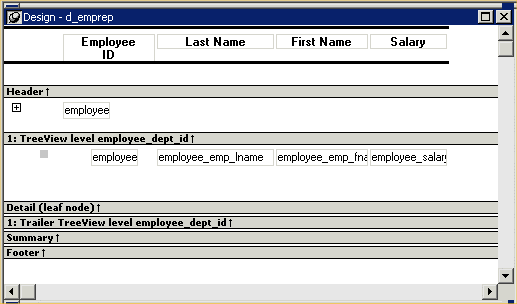
If you selected the Grid Style check box, vertical and horizontal
grid lines display:
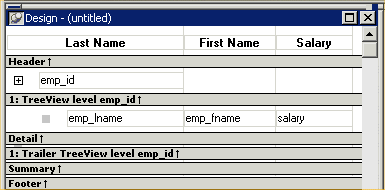
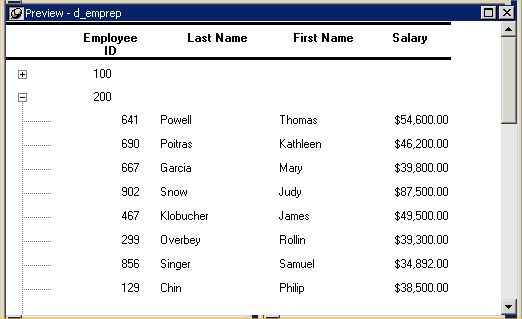
Here is the sample TreeView DataWindow object in the Preview view:
Using an expression for
a column name
If you want to use an expression for one or more column names
in a TreeView, you can enter it as the TreeView definition on the
General page in the Properties view after you finish using the TreeView
wizard.
To use an expression for a TreeView column name:
-
Open the Properties view and click the
TreeView level band in the Design view. -
Click the ellipsis button next to the TreeView
Level Definition box on the General page in the Properties view to
open the Specify Group Columns dialog box. -
In the Columns box, double-click the column you
want to use in an expression.The Modify Expression dialog box opens. You can specify more
than one grouping item expression for a group. A break occurs whenever
the value concatenated from each column/expression changes.
What you can do
All of the techniques available in a tabular DataWindow object, such
as moving controls and specifying display formats, are available
for modifying and enhancing TreeView DataWindow objects. See “Adding and deleting TreeView
levels” to read more about
the bands in a TreeView DataWindow object and see how to add features especially
suited for TreeView DataWindow objects, such as additional TreeView levels
or summary statistics.
DataWindow Object is not updatable by default When you generate a DataWindow object using the TreeView presentation style, PowerBuilder makes
it not updatable by default. If you want to be able to update the
database through the TreeView DataWindow object, you must modify its update
characteristics. For more information, see Chapter 21, “Controlling Updates in DataWindow Objects.”