More PBNI
possibilities
The ability to create visual, nonvisual, and marshaler extensions,
and to call PowerBuilder objects from external C++ applications, opens up
numerous opportunities to combine these capabilities to develop more
complex applications.
Writing an extension that loads the
PBVM
Most of the examples in this book and on the PowerBuilder Code
Samples website at
https://www.appeon.com/developers/library/code-samples-for-pb show you how
to create an extension in C++ and use it in PowerBuilder, or how to write
a C++ application that loads the PowerBuilder VM.
You could also write an extension that loads the PowerBuilder VM and
uses a custom class user object, using the techniques described in this
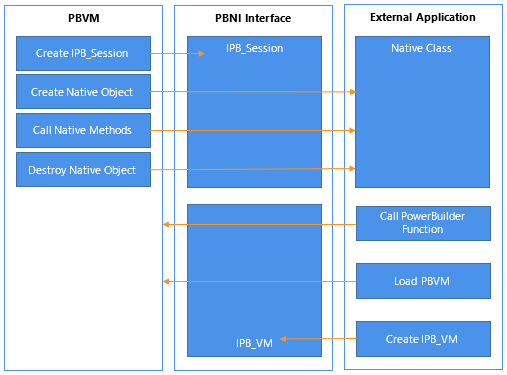
chapter. The following figure depicts the interaction between the PBVM and
an external application that uses an extension.
Figure: Interaction between PBNI, the PBVM, and external
applications
Calling PowerBuilder from
Java
You can combine the ability to call PowerBuilder classes from C++,
as described in this chapter, with the ability to create marshaler
extensions, as described in Creating Marshaler
Extensions to call PowerBuilder from Java.
One way to do this is to create a Java proxy class that declares
static native methods that can be called to load the PBVM, create
PowerBuilder sessions, create PowerBuilder objects, and invoke PowerScript
functions. These native methods can call into the PBVM through PBNI.
Additional Java classes that represent the PBVM, PowerBuilder sessions,
and PowerBuilder objects can be based on the proxy class.
The Java classes call the Java native methods through JNI, whereas
the Java native methods call PowerBuilder through PBNI.
There is a sample that illustrates these techniques on the
PowerBuilder Code Samples website at
https://www.appeon.com/developers/library/code-samples-for-pb.