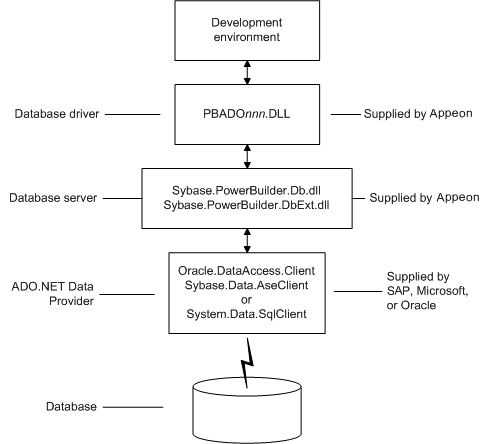
Components of an ADO.NET connection
When you access a database using ADO.NET in PowerBuilder, your
connection goes through several layers before reaching the database. It
is important to understand that each layer represents a separate
component of the connection, and that components might come from
different vendors.
The PowerBuilder ADO.NET interface consists of a driver
(pbado170.dll) and a server (either Sybase.PowerBuilder.Db.dll or
Sybase.PowerBuilder.DbExt.dll). The server has dependencies on a file
called pbrth170.dll. These DLLs must be deployed with an application
that connects to a database using ADO.NET. For Oracle 10g or Adaptive
Server 15 or later, use Sybase.PowerBuilder.DbExt.dll. For earlier
versions and other DBMSs, use Sybase.PowerBuilder.Db.dll.
The DataWindow .NET database interface for ADO.NET supports the
ADO.NET data providers listed in the following table.
|
Data Provider |
Namespace |
|---|---|
|
.NET Framework Data Provider for OLE |
System.Data.OleDb |
|
.NET Framework Data Provider for SQL |
System.Data.SqlClient |
|
Oracle Data Provider for .NET |
Oracle.DataAccess.Client |
|
SAP ADO.NET Data Provider for Adaptive Server |
SAP.Data.AseClient |
Additional .NET Framework data providers may be supported in
future releases. Please see the release bulletin for the latest
information.
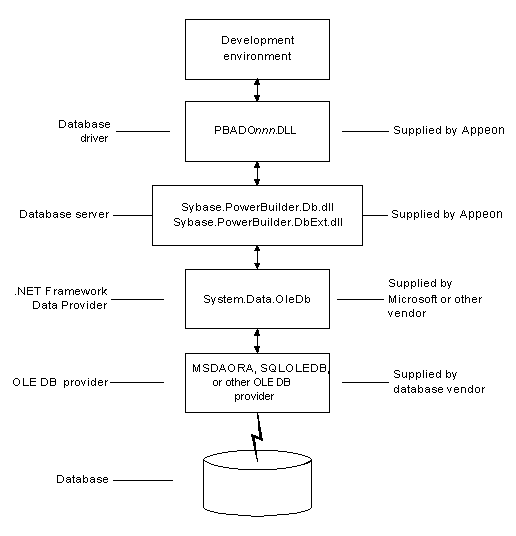
The following figure shows the general components of an ADO.NET
connection using the OLE DB .NET Framework data provider.
Figure: Components of an ADO.NET OLE DB connection
The following figure shows the general components of an ADO.NET
connection using a native ADO.NET data provider.
Figure: Components of a native ADO.NET connection